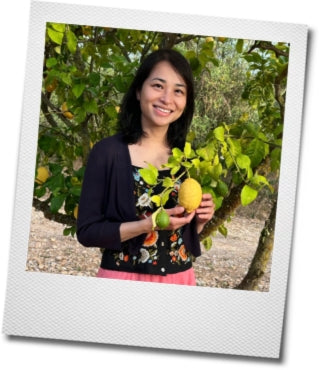
Rani Gindl invited me to her blog parade and asked a question that sounds simple but goes quite deep when you think about it: What is Selfcare for me?
My first reaction?
I don’t see a bathtub with rose petals in front of me. I see my grandmother standing quietly in the kitchen in the morning preparing herbs. I see our large family table in Vietnam, always with small bowls of fermented fruits that are good for our body and health.
What is Selfcare for me? Two worlds, one insight
At 12 years old, I came to Austria. Everything was foreign: the language, the culture, the way people here deal with their bodies. In Vietnam, I grew up with traditional medicine, in a family full of doctors who come from both modern and traditional healing practices.
What fascinated me as a child and still shapes me today: The traditional doctor never treated just the symptom. He saw the person as a whole. He was calm, grounded, balanced, and his patients became sustainably healthy.
The modern physician, on the other hand, often lives under stress, has little time for patients, and is increasingly dependent on machines. This leads many to have less and less trust in their own knowledge.
This observation showed me early on: Treating only symptoms does not solve the problem. This applies to illnesses and just as much to Selfcare.
Selfcare begins within
For me, Selfcare means: listening before the body starts to scream.
Pain is not an enemy, but always an alarm bell.
It is a signal that says: Look! Something is not right here.
Most people today have so little time for themselves that they no longer perceive these signals or want to quickly drown them out with a powder.
I have learned that true Selfcare does not mean treating yourself when you are already exhausted. True Selfcare means not letting it get that far in the first place.
What Selfcare concretely means to me
Nourishing what truly nourishes me
At home in Vietnam, there were always small bowls of fermented fruits on the table. Just for snacking, in between.
That was not a conscious health strategy, it was simply tradition. And this tradition had an effect: In Vietnam, there is far less overweight, fewer digestive problems, and more vitality in everyday life.
Fermented foods are part of my daily Selfcare because I know what they do in the body. They nourish the gut flora, strengthen the immune system, and support me from the inside out.
Plants as allies
Since my childhood, plants have fascinated me. I could watch for hours how they grow even under the toughest conditions. Wild herbs that push through asphalt, grow through fences, and simply don’t give up.
This life force is in them. And when I consciously consider what I provide my body with today, that is Selfcare for me.
That can be ginger that gives me energy, turmeric that strengthens my immune system, or ground elder that detoxifies.
I have a relationship with what nature provides.
Knowing and using energy sources
Selfcare also means for me: being honest with myself. When do I need rest? When do I need strength? When do I have to let go and when do I have to take action?
I have learned to read my body and not fight against it, but to work with it. That is perhaps the most valuable thing my background has given me.
Roots as a source of strength
My family, my history, my name: Ngoc Ha, the Pearl River. None of this is a coincidence. My roots run deep, and that exactly gives me support.
Selfcare also means for me to know and honor these roots. Not to dismiss the wisdom of ancestors, but to use it as a foundation while being open to what the modern world has to offer.
What Selfcare is not for me
Selfcare is not a to-do list for me and above all, it is not a one-size-fits-all solution.
What works for one person may not suit the next at all. That’s why I find it so important to get to know your own body and listen to it.
Selfcare is an attitude
What I have taken away after all these years from Vietnam and Austria, from the pharmaceutical industry and traditional medicine, is this: Selfcare is not a break from life. It is life.
It’s about making small daily decisions that (nourish) me, and I mean that physically and emotionally.
Sometimes it’s a bowl of fermented pomelo in the afternoon. Sometimes a long walk. Sometimes consciously pausing and listening to what my body wants to tell me right now.
Thank you, Rani Gindl, for this wonderful invitation to reflect. 💛